
-
North Tallahassee
(850) 782-3232
-
South Tallahassee
(850) 782-3232
- Free Orthodontic Consultation


If you’re trying to decide between Invisalign vs braces, you probably already know the obvious differences. Invisalign uses clear, removable aligners. Braces use brackets and wires that stay attached to your teeth.
But that’s usually not what patients really want to know.
They want to know: which one will actually work better for their smile, whether Invisalign can really fix their bite, whether they’ll need attachments or rubber bands, how strict the 22-hour wear rule really is, why the orthodontist treating them matters if Invisalign uses computer software, what happens if their teeth don’t move the way the computer predicts, and how much all of this is actually going to cost.
Those are much better questions.
At Redemption Orthodontics, we offer both Invisalign and traditional braces, and we don’t believe one treatment is automatically better than the other.
Whenever possible, we take your treatment preference into consideration. But there are also cases where a specific tooth movement, bite problem or treatment goal makes one option more predictable than the other.
Our job isn’t to sell you Invisalign or braces. It’s to understand your smile, explain what we see and recommend the treatment we believe gives us the best path toward the result we’re trying to achieve, treating you like our own child, sister, or brother along the way.

Invisalign Is More Than a Set of Clear Aligners
This is one of the biggest misconceptions about Invisalign.
Invisalign makes the aligners. Your orthodontist designs the treatment.
Invisalign’s technology is incredibly sophisticated. Its ClinCheck system allows orthodontists to visualize proposed tooth movement and digitally plan treatment before your aligners are manufactured.
But the software is a tool. It doesn’t replace clinical judgment.
Your doctor still has to determine:
- Where each tooth should ultimately be positioned
- How those teeth need to move
- How your bite should fit together
- Which movements should happen first
- Whether attachments are needed
- Whether elastics are necessary
- Whether spacing or IPR should be incorporated
- Whether the proposed movement is biologically and clinically realistic
- And whether Invisalign is even the best appliance for your particular case
Invisalign’s own provider analytics track ClinCheck modifications per case, because orthodontists can review and change the proposed digital treatment plan rather than simply accepting an initial computer setup.
That’s an important distinction. At Redemption Orthodontics, Drs. Michael & Taylor Vracar use Invisalign’s planning tools actively for each tooth, down to the 1/10th of a millimeter.
They’re not simply asking a computer to straighten the teeth and approving whatever comes back. They’re programming treatment based on the individual patient in front of them.
Why Does Diamond+ Invisalign Experience Matter?
Redemption Orthodontics is a Diamond+ Invisalign Provider. That designation reflects significant experience treating patients with the Invisalign system.
But we don’t think Diamond+ should simply be a logo on the bottom of a website.
The value is what experience teaches you. As of September 2026, our doctors have actively completed over 15,000 ClinChecks and modifications.
With more cases comes more opportunity to understand:
- Which movements tend to respond predictably to aligners
- Where a digital setup may need to be modified
- How attachments can be used strategically
- When elastics may improve bite correction
- How to stage movements
- What to watch for as treatment progresses
- When a tooth isn’t tracking the way we expected
- When additional aligners may help
- And when Invisalign is no longer the most predictable tool for the job
Our doctors make modifications with a clinical purpose. The goal isn’t to change a digital setup simply for the sake of changing it. The goal is to use their understanding of orthodontic movement, the patient’s anatomy and the way the teeth are responding to create a more individualized treatment plan.
What If My Invisalign Treatment Started Somewhere Else?
We occasionally meet patients who started Invisalign treatment with another provider but aren’t happy with how treatment is progressing or how their smile is finishing. We accept and frequently help transfer Invisalign patients navigate their case.
We don’t approach those cases by trying to determine who did something “wrong.” Orthodontic treatment isn’t always that simple.
Teeth don’t always respond exactly as anticipated. Biology varies from patient to patient. A movement that looked straightforward digitally may prove more difficult clinically. And sometimes a treatment plan simply needs a different approach.
Our question always is: where are you now, and what is the most predictable way to get you where you want to be?
If a patient is committed to continuing treatment, our doctors can evaluate what has already been accomplished and what still needs to change.
Depending on the case, that may involve:
- Modifying the Invisalign treatment plan
- Changing attachments
- Adjusting staging or mechanics
- Adding elastics
- Taking a new digital scan
- Ordering refinement aligners
- Or transitioning to braces when fixed appliances would give us better control
Our goal isn’t to protect the treatment modality. It’s to finish your smile and get you to happy.
Can Invisalign Treat Complex Cases?
As a Diamond+ Provider, yes, Redemption Orthodontics can treat far more than a few mildly crooked front teeth with Invisalign.
Modern Invisalign treatment can be used for many types of crowding, spacing and bite correction when the case is selected and planned appropriately.
At Redemption Orthodontics, we offer the Invisalign portfolio appropriate for different levels of treatment, including:
- Invisalign Comprehensive for more involved orthodontic treatment
- Invisalign Lite for cases requiring a more limited amount of correction
- Invisalign Express for select minor orthodontic movements
- Invisalign First for appropriate Phase 1 orthodontic treatment in growing children
But being highly experienced with Invisalign doesn’t mean trying to treat every orthodontic problem with aligners.
Sometimes expertise means knowing when you would rather use braces for safety, predictability, patient compliance, and time in treatment.
When Might Braces Be More Predictable?
Certain orthodontic movements may give our doctors greater or more predictable control with braces.
Depending on the individual patient, examples may include:
- Significant upper front-tooth torque or angulation
- Major space closure
- Certain premolar extraction cases
- Situations where very precise root positioning is important
- Certain tooth-size and positioning concerns
One example can be patients with smaller upper lateral incisors, sometimes called the upper “twos.” Those teeth may require very precise positioning and finishing to create the right spacing and relationship with the surrounding teeth. In some of those cases, our doctors may feel that braces give us more predictable control over the final position.
What About Jaw Surgery?
Patients who require surgical orthodontic treatment are generally not patients for whom we would recommend Invisalign.
Surgical cases often require extremely precise positioning and coordination before and after jaw surgery, and we typically prefer fixed appliances for that level of control.
None of this means Invisalign is “less effective.” It means orthodontic appliances are tools. Experienced treatment planning means choosing the right tool for the movement you’re trying to accomplish.
What Is Invisalign Really Like Every Day?
We would rather tell you what Invisalign is actually like before treatment than let you discover everything after you’ve already started.
The biggest responsibility is straightforward: we recommend 22 hours of Invisalign wear every day.
Your aligners generally come out only to:
- Eat
- Drink anything other than water
- Brush
- Floss
Then they go back in. The benefit is flexibility and comfort.
You don’t have traditional braces food restrictions because the aligners are removed for meals. Brushing and flossing can also be simpler because there are no brackets or wires to clean around.
According to Dr. Tate Chauncey, a popular orthodontist in Henderson, NV, if you’re active or play sports, it’s worth thinking through how braces or aligners will actually fit your daily routine before you decide, since that lifestyle fit matters just as much as the clinical fit.
But removable does not mean optional. The aligners can’t move your teeth while they’re sitting on the counter. If someone consistently leaves their aligners out for several hours a day, treatment may slow and the teeth can begin to fall behind the planned movements.
What Does It Mean When My Teeth Aren’t “Tracking”?
You’ll probably hear the word tracking during Invisalign treatment.
Tracking means your teeth are fitting into the aligners and moving approximately as planned.
Sometimes a particular tooth doesn’t move as predicted. You may notice a space developing between the tooth and the aligner, or our team may recognize during a progress check that a tooth is falling behind the digital plan.
That’s something we want to address rather than simply continuing through the next ten trays.
We look at why it isn’t tracking. It might be that:
- Wear time needs to improve
- The tooth needs more time
- An attachment needs to be changed
- The movement needs to be restaged
- Elastics would help
- Or that patient’s biology simply isn’t responding exactly like the digital simulation predicted
That’s where orthodontic supervision matters.
Will I Have Attachments With Invisalign?
Yes, all patients will likely have attachments on their teeth.
Attachments are small, tooth-colored shapes bonded to particular teeth. They give the aligners something to grip and help us create movements that would be more difficult with a smooth aligner alone. This is part of why online aligner companies cannot move teeth as predictably.
Depending on your bite and treatment goals, you may also need elastics, even while wearing Invisalign.
So while Invisalign is much less noticeable than traditional braces, it isn’t necessarily an invisible tray floating over untouched teeth.
We’ll explain what we expect your particular treatment to involve during your free consultation at our office with our experienced treatment coordinators.
What Are Invisalign Refinements?
Your first series of aligners may not be your last.
That isn’t automatically a sign that something went wrong.
Teeth are living biological structures. They don’t always move exactly the way a digital model predicts.
Once you finish a series of aligners, we may determine that some teeth or your bite would benefit from additional movement. We can take another scan and create an additional series of aligners. That’s called a refinement.
For Invisalign Comprehensive treatment at Redemption Orthodontics, we currently include up to three refinement rounds as part of treatment.
We are flexible with our patients, and if additional treatment beyond what’s included becomes necessary or desired, we’ll talk with you about the options before moving forward, together.
What Happens If I Don’t Wear My Aligners Enough?
We’ll have an honest conversation about it. Not a lecture.
If your teeth have stopped tracking because the aligners aren’t being worn consistently, we need to figure out what gives you the best chance of successfully finishing treatment.
Depending on the situation, options can include:
- Improving wear and allowing the current aligner more time
- Taking another digital scan
- Ordering refinement aligners
- Modifying the Invisalign treatment plan
- Transitioning into braces for more predictable control
- Or, in certain circumstances, discussing whether it makes sense to stop active treatment and retain the current result
Invisalign can be a fantastic orthodontic treatment. But it requires participation.
If you already know that 22-hour wear is going to be difficult, tell us during your consultation. Braces might actually make orthodontic treatment easier for your life.
What Is the Invisalign Scan Like?
No goopy impressions here.
Redemption Orthodontics uses the Invisalign iTero Lumina intraoral scanner. The scanner creates a detailed digital model of your teeth without traditional impression material.
A full-mouth scan can be completed in as little as 2 minutes. That means:
- No trays filled with impression material
- No goop
- No gagging
- No uncomfortable molds
The digital scan gives our doctors detailed information they can use when evaluating and planning your Invisalign treatment.
What Happens at My Free Invisalign Consultation?
This is where everything you’ve been reading online becomes about your smile.
Your initial consultation at Redemption Orthodontics is free.
Our clinical team obtains the appropriate records so our doctor can evaluate your teeth and bite.
Then we talk. What do you want to change? What’s bothering you? Are you mostly concerned about appearance? Is there something about your bite? Are you hoping for Invisalign because of work, school, sports or lifestyle? Do you have strong feelings about braces?
Those things matter.
The doctor then evaluates what actually needs to move and determines which treatment options make clinical sense.
Sometimes the answer is: Invisalign would work beautifully. Sometimes it’s: we would strongly prefer braces for this movement. And sometimes it’s: either one can work, which would you rather live with?
Your Treatment Coordinator Helps Turn the Doctor’s Plan Into Your Plan
Your doctor determines what’s clinically appropriate. Then your Treatment Coordinator, or TC, helps you understand what that recommendation means in real life. This is one of the most important parts of your consultation.
Your TC can help you understand:
Your treatment options. If both braces and Invisalign are reasonable options, we’ll explain the differences. If the doctor prefers one treatment for a particular clinical reason, we’ll make sure you understand why.
What Invisalign will require from you. We’ll talk about 22-hour wear, meals and drinks, attachments, elastics, tray changes, tracking, refinements, appointments, work and school, sports, travel, vacations, photos and special events, and the realities of actually living with removable orthodontic treatment.
Your estimated treatment time. Treatment duration depends on what we’re correcting and how much movement is required. We’ll give you an estimated timeline based on your records and specific alignment needs, not an internet average.
Your treatment fee. Your TC will explain the actual treatment fee your doctor recommends and what is included.
Your insurance and financial options. They can also help review estimated orthodontic insurance benefits when applicable, available Redemption savings or discounts (including military, education, clergy, and first responder discounts), down-payment options, monthly-payment options, 0% interest in-house financing, other available financing options, and HSA and FSA payment options.
Our goal is for you to understand the clinical plan and the financial plan before you decide whether you want to move forward.
How Much Does Invisalign Cost?
Invisalign treatment at Redemption Orthodontics generally ranges from approximately $3,500 to $7,400.
Where a patient’s fee falls within that range depends on factors such as:
- How much correction is needed
- The complexity or severity of the case
- Which Invisalign treatment package is appropriate
- And the anticipated duration of treatment
More limited treatment will generally fall toward the lower end of the range. More comprehensive treatment will generally fall toward the higher end.
Why Might Invisalign Be Priced Differently From Braces?
Invisalign treatment includes an additional laboratory and manufacturing component because an individualized series of aligners is being digitally planned and manufactured specifically for the patient. That’s one reason the fee for Invisalign and braces may differ.
We don’t want to make that sound ominous or mysterious. It’s simply part of how the two treatment systems are different.
At your free consultation, your TC will show you the actual fee for your treatment options. If braces and Invisalign are both appropriate choices, we can explain the cost of each so you can make an informed decision.
What If I Start Invisalign and Later Need Braces?
Sometimes treatment changes. Maybe aligner wear isn’t working well with a patient’s lifestyle. Maybe a specific tooth isn’t responding predictably. Maybe the bite reaches a point where fixed appliances would give the doctor better control. Or maybe the patient simply decides they would rather finish in braces.
If switching treatment types becomes appropriate, we’ll explain why we’re recommending the change, what it means for your treatment, whether additional treatment time may be needed, and whether there will be an additional fee.
Sometimes, changing modalities doesn’t incur a cost. Depending on the issue, changing modalities can involve additional materials, doctor time and laboratory costs, so an additional fee could possibly apply.
If it does, we’ll discuss it before moving forward, because we believe in transparency. Like a good marriage, expectations are set on the front end, like who is doing the dishes and who isn’t.
We also try to keep additional costs as reasonable as possible and may offer payment arrangements when appropriate.
What About Invisalign for Kids and Teens?
Invisalign isn’t only for adults.
For appropriate younger patients, Invisalign First can be used for certain Phase 1 orthodontic needs. Teens can also be excellent Invisalign patients.
But age isn’t the deciding factor. We look at:
- What orthodontic problem we’re trying to correct
- The patient’s growth and development
- Which tooth movements are needed
- Whether aligners are clinically appropriate
- And whether the patient can reliably manage 22-hour wear
We’re also intentionally selective about early orthodontic treatment. While the American Association of Orthodontists (AAO) recommends an evaluation for all children by the age of 7, that does not automatically mean we want to treat every 7-year-old.
Sometimes the best orthodontic plan is simply to monitor growth and wait. We offer free check-ups for all children ages 7 and up every 6 months, until they are ready for treatment.
Invisalign vs. Braces at a Glance
| Factor | Invisalign | Traditional Braces |
|---|---|---|
| Appearance | Clear and less noticeable | Visible metal brackets and wires |
| Removable | Yes | No |
| Daily wear | 22 hours per day | Attached continuously |
| Meals | Remove aligners to eat | Certain hard/sticky foods should be avoided |
| Brushing/flossing | Remove aligners | Clean around brackets and wires |
| Compliance | Wear time is extremely important | Hygiene, elastics and appointments still require cooperation |
| Attachments | Often used | Not applicable |
| Elastics | May be needed | May be needed |
| Complex cases | Can treat many complex cases when appropriately selected and planned | May provide more predictable control for certain movements |
| Additional aligners | Refinements may be needed | Adjustments continue throughout treatment |
| Best option | Depends on your anatomy, bite, movements, preferences and compliance | Depends on your anatomy, bite, movements and preferences |
So Is Invisalign or Braces Better?
There isn’t one answer. And we think that’s a good thing.
At Redemption Orthodontics, we don’t begin with, “How can we put this patient into Invisalign?” We don’t begin with, “This looks complicated, so let’s use braces.”
We begin with the patient. What needs to move? What does the bite need to do? What’s most predictable? What does the patient want? What will actually work with their life? And what treatment would we be comfortable recommending if this were someone in our own family?
If Invisalign is a great option, our doctors have extensive experience using and customizing the system. If braces give us a more predictable path, we’ll tell you why. And if both treatments can accomplish the result we’re trying to achieve, you may simply get to choose.
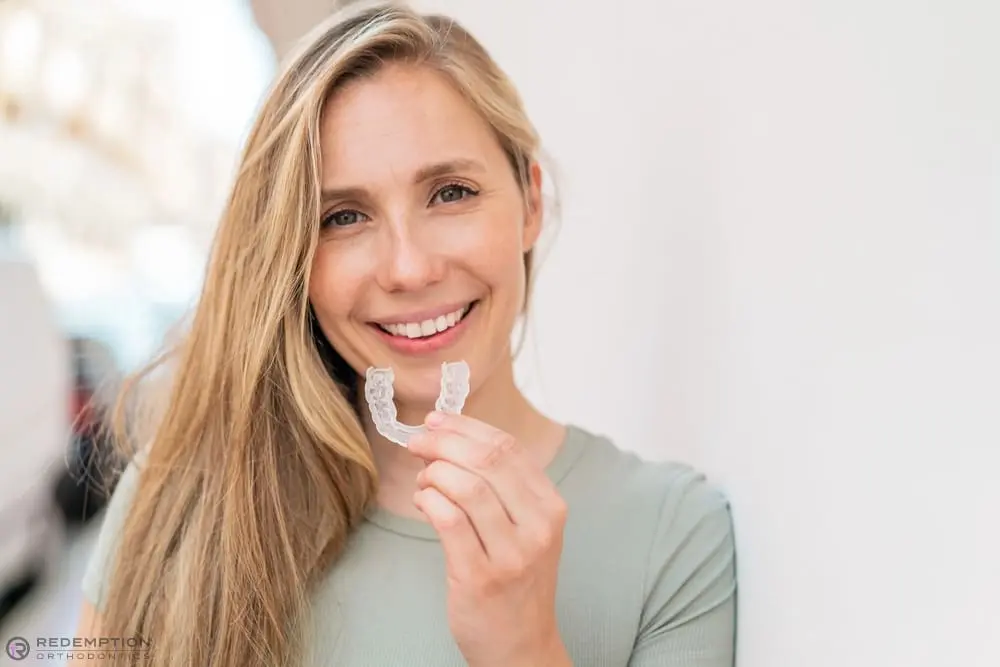
Come Find Out What We Would Recommend
You don’t have to decide between Invisalign and braces before making an appointment. That’s what your consultation is for.
Your consultation at Redemption Orthodontics is free.
We’ll evaluate your teeth and bite, listen to your goals, and explain the options we believe make sense. Then your Treatment Coordinator will help you understand what each choice means in everyday life, how long treatment is expected to take, your insurance and financial options, and exactly what your treatment will cost.
We want you to leave knowing:
- What we recommend.
- Why we recommend it.
- What treatment will require from you.
- How long we expect it to take.
- And what it will cost.
Then you can decide what’s right for you, your family, and your smile!
Also Worth Checking Out
Affordable Braces Cost in Tallahassee, FL – Get Your Perfect Smile! Investing in braces is…
Braces For Kids Early Orthodontic Treatment With Braces As a patient at Redemption Orthodontics, you…

Need help understanding how to floss with braces in Tallahassee, FL? Flossing supports overall oral…